
Emotions are not obstacles to be managed. They are a readout of where your well-being currently stands, and their intensity tells you how far from balance you are.
Most advice treats difficult emotions as the problem. Something to be calmed, controlled, or got past so you can return to normal.
That framing makes them your opponent. It also throws away the most useful information you have.
Emotions Are Indicators
Your emotions are a direct reflection of your current level of well-being. Not a random weather system. Not a malfunction. A readout.
Think of the fuel gauge in a car. When it reads low, the gauge is not the problem, and covering it with tape does not put fuel in the tank. The reading is doing its job. It is telling you something true about the state of the system.
Emotions work the same way. A difficult one is not evidence that something has gone wrong with you. It is a signal that some belief about your situation is registering a threat to your well-being.
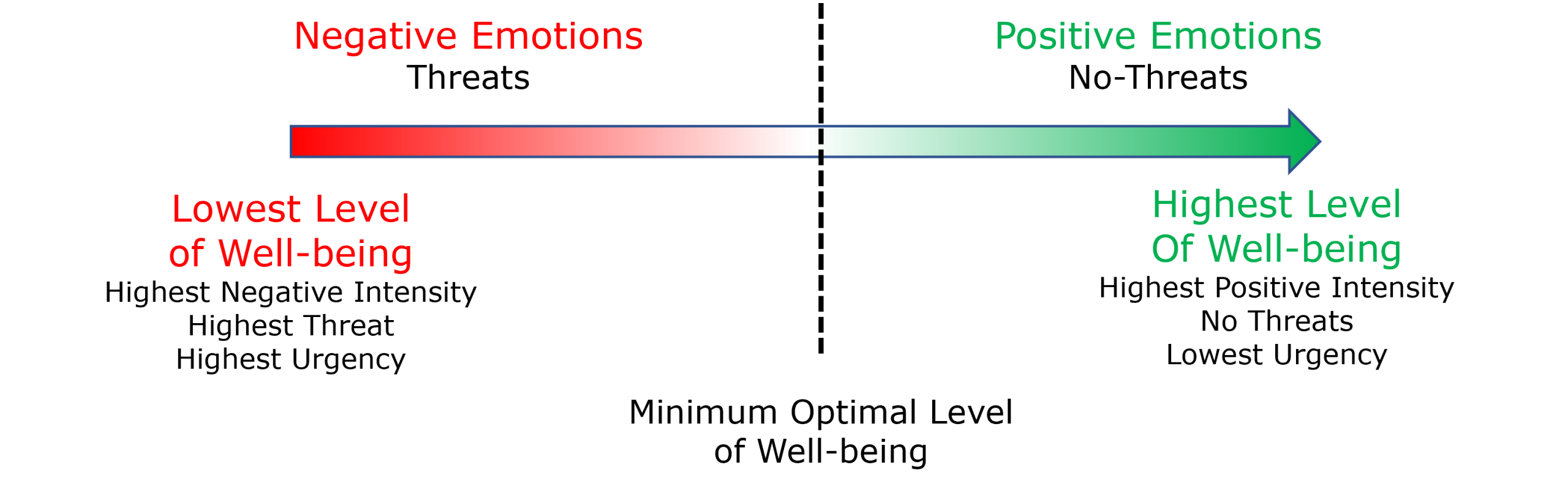
Your overall emotional state at any moment, the collection of everything running at once, is your mood. Mood reflects your overall level of well-being right now.
Intensity Is Part of the Signal
The strength of an emotion is not noise. It tells you how significant the perceived threat is, or how significant your brain currently believes it to be.
That distinction matters. Sometimes the intensity is proportionate and worth acting on. Sometimes it is wildly out of scale with what actually happened, and that mismatch is itself informative. A reaction far larger than the event usually means something older has been touched.
Either way, the intensity is data rather than an embarrassment.
What They Are Pointing At
Here is the part that makes this practical rather than philosophical.
Every difficult emotion, however complicated it feels, comes back to one of three themes: trust, value, and acceptance.
Fear points to a shortage of trust, a belief that you cannot handle what is coming. Shame points to a shortage of value, a belief that you do not matter or are not enough. Anger points to a shortage of acceptance, a fight with something that has already happened or that is not yours to control.
Most emotions are combinations. Overwhelm, for instance, tends to have all three running at once.
So when you ask what an emotion is telling you, there is a specific answer available rather than a vague one. It is telling you which of those three is currently low. For a short overview of all three together, see the three themes.
Positive Emotions Are Readouts Too
This works in both directions, and the upward direction gets neglected.
When you feel settled, capable, or genuinely content, that is also a reading. Some belief about trust, value, or acceptance is currently strong. Worth noticing, because those moments are evidence, and evidence is exactly what you need later when a difficult belief is trying to convince you it has always been this way.
Positive emotions build a reservoir you can draw on. But only if you stop to register them rather than letting them pass unremarked, which is what the negativity bias would prefer.
What Changes When You Believe This
Two things.
You stop fighting your emotional state, which is a fight nobody wins and which generates most of the extra suffering on top of the original difficulty.
And you start asking a better question. Not “how do I make this stop”, but “what is this telling me”. The first question has no good answer. The second one leads somewhere.
Micro Practice: Read the Gauge
- When something difficult arrives, pause before doing anything about it.
- Name what you are feeling, as best you can.
- Ask which of the three is low. Am I not trusting that I can handle this? Am I not valuing myself here? Am I fighting something I cannot control?
- You do not have to fix it. Seeing which one it is, is the step.
Where This Leads
Reading the gauge is the work of Insight, the third step. It needs Mindfulness to notice the emotion in the first place and Compassion to look at what you find without turning it into an attack.
If the distinction between a sensation and an emotion is new to you, start with feelings and emotions are not the same thing.
For the full model, see Understanding Well-Being.