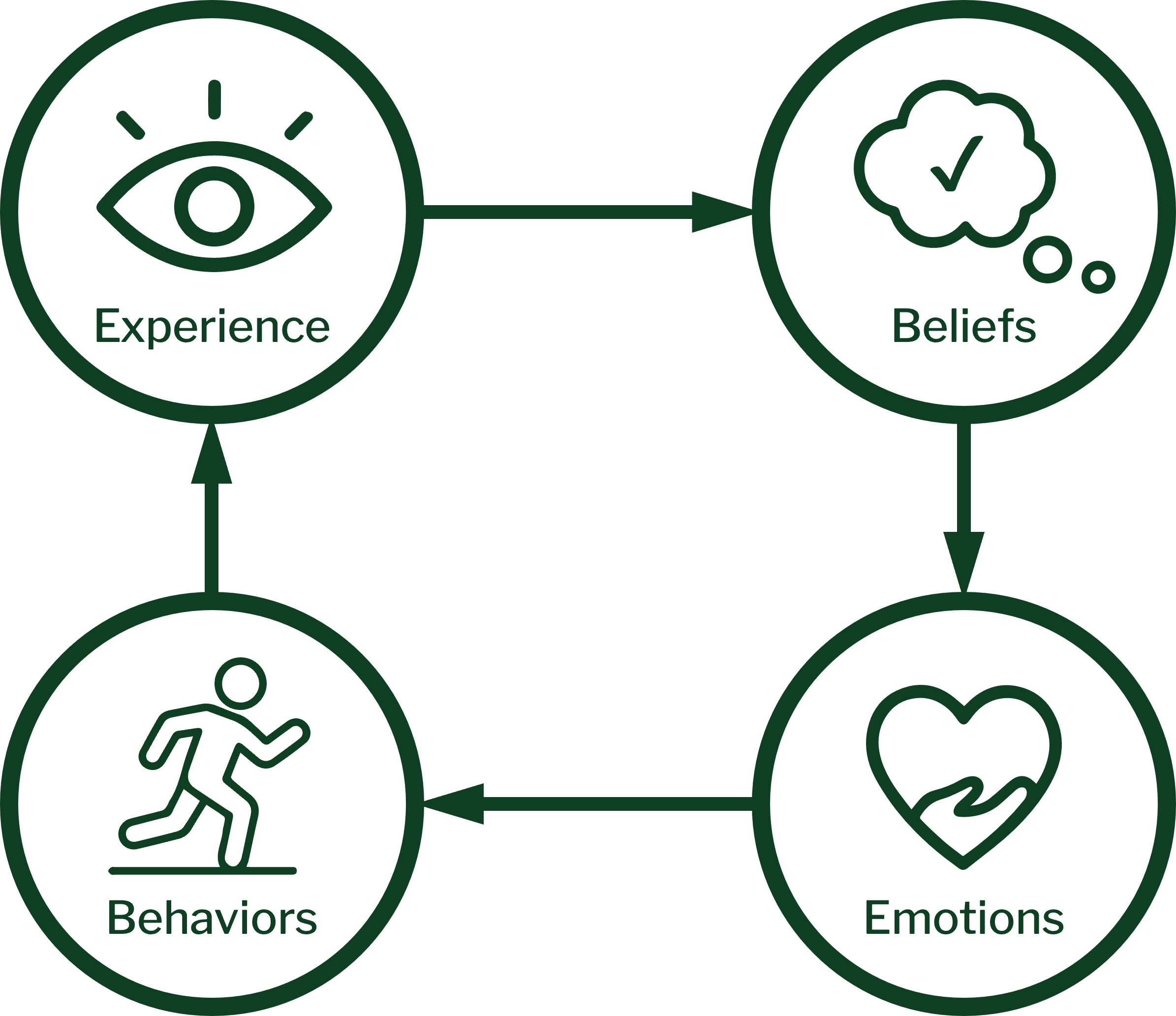
 ExperienceBeliefsEmotionsBehaviors
Stage Three
Understanding Emotions
Once our beliefs decide what an experience means, our brain and body report back on how it affects our well-being.
That report is an emotion.
What Makes Up an Emotion?
An emotion is more than a feeling. It is three things working together.
One
Feeling
The physical sensation in the body
Two
Context and Meaning
What our beliefs say it means
Three
Label
The name we give the experience
Emotion
The Feelings We Notice
- Racing Heart
- Tightness in the Chest
- Churning Stomach
- Warmth in the Face
- Lightness or Calm
The Labels We Give Them
- Excitement
- Anxiety
- Anger
- Relief
- Sadness
- Joy
Between the feeling and the label sits meaning. That is where our beliefs do their work.
The Same Feeling, Two Emotions
A sensation on its own does not tell us much. The context does.
A racing heart
Before a roller-coaster ride
Excitement
A racing heart
Before a job interview
Anxiety
The sensation is identical. The belief is different. So is the emotion.
Emotions Are Feedback
Not obstacles to suppress. Not verdicts about reality. A report of what our brain currently believes.
The feeling is real.
The feeling is genuine. The body is not pretending.
It may not be accurate.
The belief producing it may be exaggerated, outdated, or simply mistaken.
Read It Backward
Every emotion is a pathway back to the belief that made it.
What the Intensity Tells Us
Mildly uneasy, or deeply anxious. The strength of an emotion is information too.
Mild
Intense
A mild emotion. Relatively little appears to be at stake.
A powerful emotion. Something important seems to be gained, lost, or threatened.
Intensity tells us how strongly our brain believes it, not whether it is right.
Positive and Negative Emotions
Both are doing the same job. They simply point in different directions.
Well-being Supported
Positive Emotions
Encourage us to continue, explore, connect, and engage.
- Joy
- Relief
- Interest
- Gratitude
- Contentment
- Excitement
Well-being at Risk
Negative Emotions
Draw our attention toward something that seems to need a response.
- Fear
- Anxiety
- Anger
- Sadness
- Shame
- Frustration
Negative emotions are uncomfortable on purpose. Discomfort is how they get our attention.
They do not prove something is wrong. They mean our brain believes something important may be at risk.
How Emotions Guide Behaviour
Every emotion arrives already prepared to act.
Fear
Escape, or avoid.
Anger
Confront, or defend.
Sadness
Withdraw, rest, or seek support.
Joy
Continue, connect, and explore.
When the belief underneath is accurate, that push is useful. When it is exaggerated or outdated, the same push sends us the wrong way.
To change behavior, we must change the beliefs producing the emotion, not fight the emotion itself.
Reading Our Emotions
Emotions make more sense once we can recognize all the parts of them.
That’s exactly what the 4-Steps™ help us do.