Level One
Reflexes
Reflexes are the behaviors our body carries out without asking us first.
They are involuntary and automatic. A blink when sand blows into our eyes. A stomach that starts to churn when nutrients run low. A head that snaps toward a sudden noise before we know what the noise was.
None of these were decided on. By the time we notice them, they have already happened.
 ActionsReactionsReflexes
What Makes a Behavior a Reflex
Three things separate a reflex from everything else we do.
Involuntary
No decision is made. There is no moment where we could have chosen otherwise, because the choosing part of us was never consulted.
Automatic
The same input produces the same response, every time, at a speed no deliberate thought could match.
Unconscious
We have no view of the processing. We become aware of the reflex only after our body has already carried it out.
Reflexes are the behaviors attached to our inherent functions: the ones we are born with, or that appear within days of birth. Breathing. Heart rate. Temperature. Digestion. The coordinated movement of arms and legs.
We did not have to learn these. They came with us.
Where Reflexes Are Managed
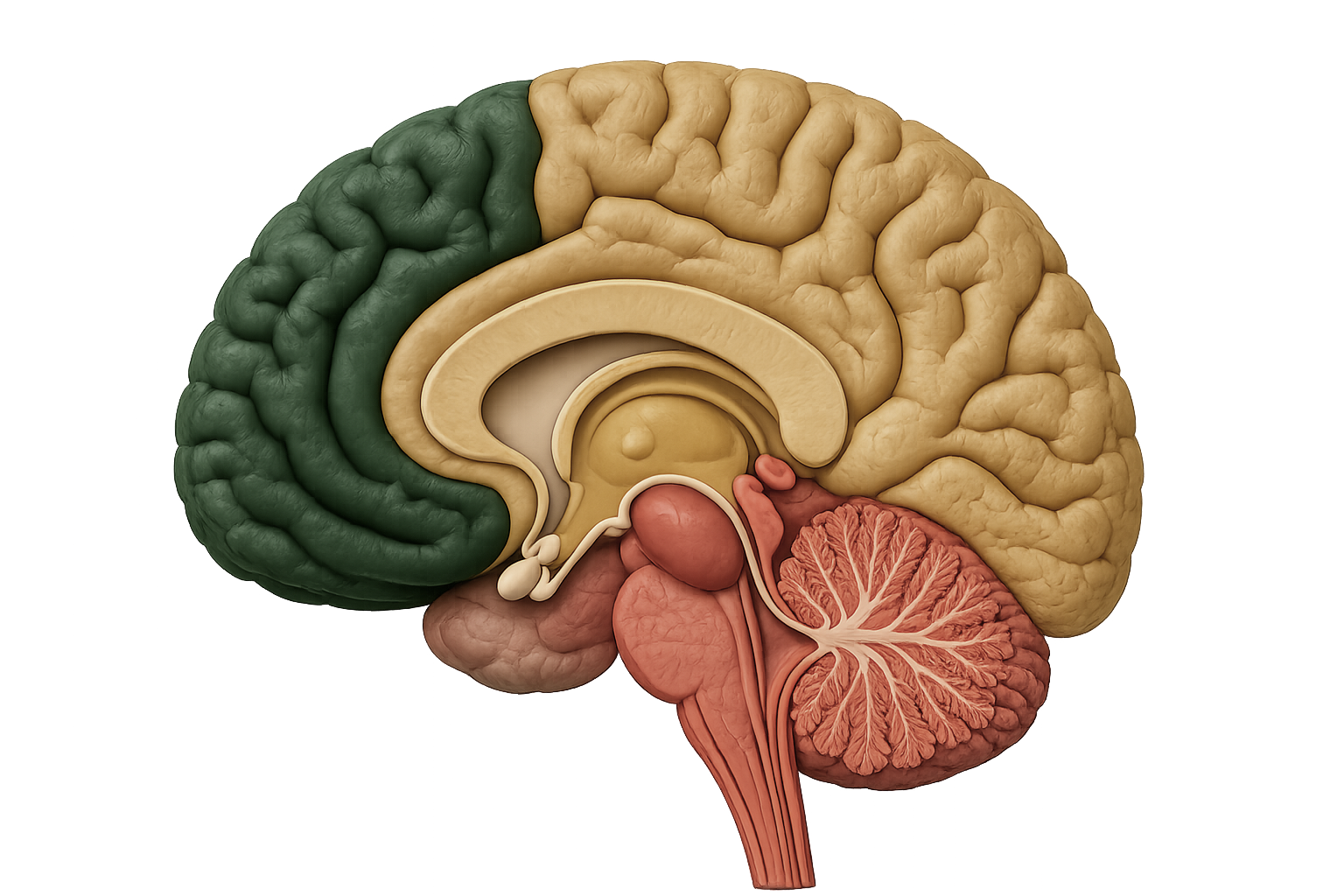
Reflexes are handled by the oldest structures in the brain, which we call the amygdala region.
That name covers the amygdala itself along with the other limbic and subcortical structures around it: the brainstem, which manages breathing and heart rate, and the hypothalamus, which regulates temperature. Every sensory input we receive passes through here first, including signals from inside the body.
Brain region
Amygdala Region
Sometimes called the lizard brain. Evolutionarily the oldest part of us, and the fastest.
Recognition
Unconscious
The recognition happens, but not where we can see it. Only the result reaches us.
Take hunger. Our brain measures the nutrients in our blood, concludes they are low, releases chemicals into the stomach and starts the muscles moving. We are aware of none of that. What reaches us is a churning stomach, and we have learned to call that hungry.
The reflex ends there. Everything after it, deciding to look for food, choosing what to eat, belongs to a higher level.
Reflexes Through the Day
Most of what keeps us alive today will happen without our involvement.
The Blink
Sand blows toward our face. The eyelids close and the tear ducts open before we register the sand.
The Startle
A door slams. Our head turns and our heart rate jumps, all of it decided somewhere we cannot reach.
The Churn
Nutrients drop. Digestion prepares itself. We experience it as hunger arriving out of nowhere.
The Reaching
A newborn looks around, touches, grasps. The urge to learn is itself inherent, and involuntary.
Reflexes are not the unimportant end of behavior. They are the building blocks every higher behavior is assembled from.
Feel the Boundary Yourself
There is a line between what we control and what our body manages on its own. You can find it in about twenty seconds.
Try this
One. Breathe in and hold it. Count slowly to fifteen.
Two. Notice the moment your body begins to push back. There is a point where holding stops feeling like a choice and starts feeling like a demand. That push is the amygdala region doing its job, managing a function it will not let you override for long.
Three. Now blink a few times on purpose. You chose that. The next time you blink without thinking, that will be a reflex, run by the same region.
You have just felt the edge of your own control.
Why Reflexes Matter to Us
We cannot change a reflex. That turns out to be useful information.
A great deal of self-criticism is aimed at behavior that was never ours to control. The jolt of a racing heart, the tightening of a stomach, the flinch. There is nothing broken about you for having them, and no amount of effort will make them stop arriving.
What we can change is everything that comes after. The meaning we give the sensation, the emotion that follows, and what we then choose to do. That work happens at the levels above this one.
Knowing which behaviors are not ours to control tells us where our effort actually belongs.