Level Three
Actions
Actions are the behaviors we think through before we carry them out.
Planning a trip. Learning a language. Deciding to have a difficult conversation rather than avoid it. Imagining a future and then moving toward it.
This level is deliberate, and as far as we know, it is ours alone among animals.
 ActionsReactionsReflexes
What Makes a Behavior an Action
One quality separates an action from a reaction: we were present for the decision.
Voluntary
Chosen, and able to be unchosen. We can stop partway through and take a different road.
Deliberate
Thought through. Options are weighed against each other before one of them is picked.
Proactive
Aimed at something ahead of us rather than triggered by something behind us.
Actions belong to our executive functions: cognition, language, imagination, visualising, planning. These are the functions that only exist in a mind that can consciously recognise what is happening.
A reaction answers the past. An action answers the future.
Where Actions Are Managed
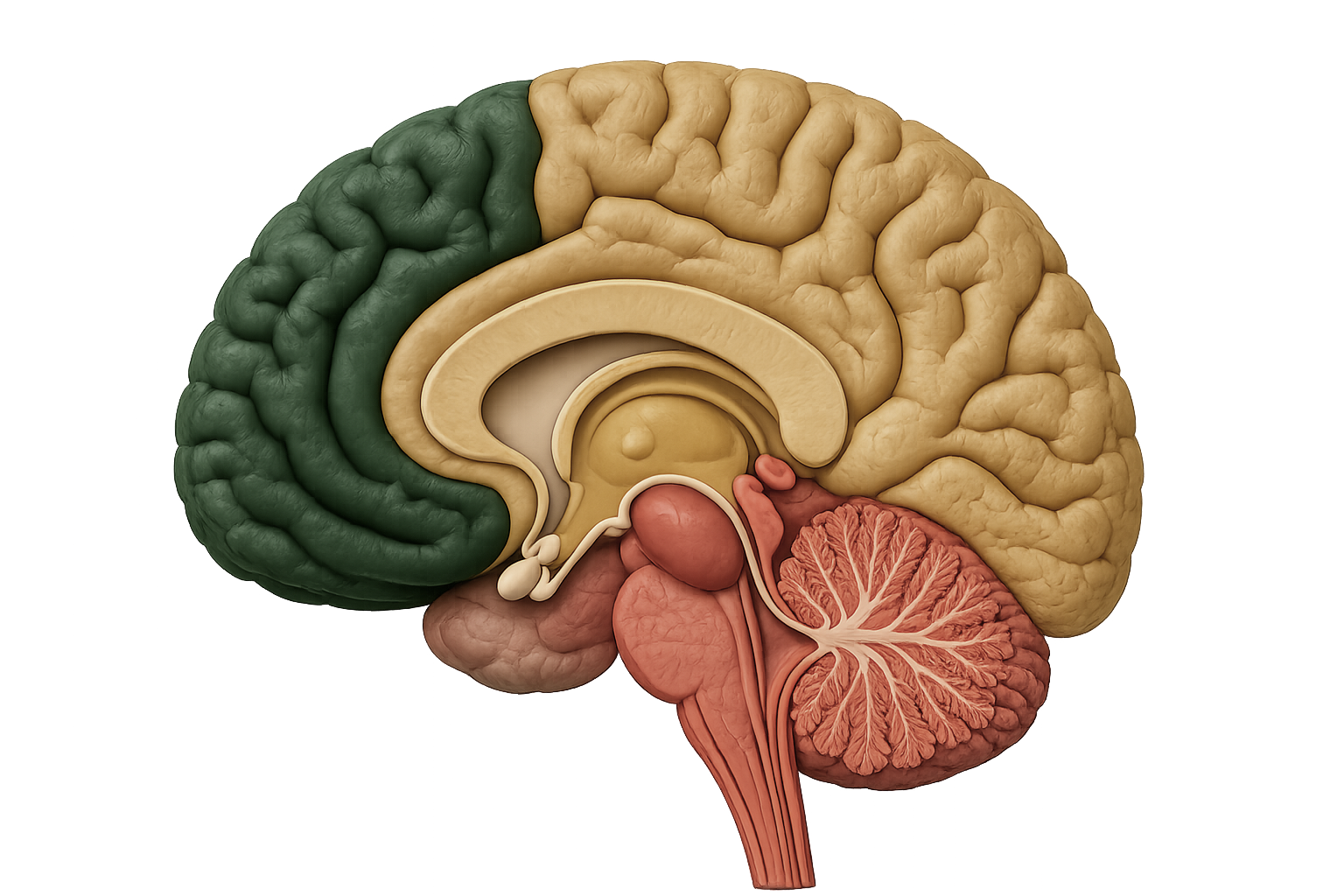
Actions are coordinated by the prefrontal cortex, which researchers call our executive centre.
Every level below still does its work. Input passes through the amygdala region for a fast first read, the neocortex adds its pattern matching and proposes a response, and then that proposal arrives with us. We can accept it, or we can reconsider it using something no other level has: imagination. We can picture outcomes that have not happened yet and weigh those too.
Once we decide, the instruction travels back down. The neocortex fills in the mechanics, the amygdala region moves the muscles. Deciding to swim is ours. Which stroke is ours. How each fibre contracts is delegated.
Brain region
Prefrontal Cortex
Oxford researchers mapping this region found an area in the human frontal cortex with no equivalent in the monkey brain at all.
Recognition
Conscious
We can see the processing and comment on it. Those comments are what we experience as thoughts.
This capacity arrives at around four or five years old, which is also when our lasting autobiographical memories begin. It is not a coincidence. Before then there was no observer to record the story.
The Move Only This Level Can Make
We can watch the lower levels working, and then interrupt them.
An animal given the same input will produce the same behavior, every time. We can observe the response forming, stop it, introduce information that does not exist anywhere in the situation, and behave completely differently as a result.
One
Observe
Notice the reaction taking shape before it runs
Two
Interrupt
Hold it there rather than letting it complete
Three
Choose
Bring in new options and pick deliberately
This is the whole mechanism behind the 4-Steps™. Mindfulness is the observing. Compassion makes it safe to look. Insight finds the belief driving the reaction. Reframing replaces it.
Every one of those four steps is an action.
Turn One Reaction Into an Action
Not all of them. One, and a small one to begin with.
Try this
One. Pick a reaction you know well. The reach for the phone. The sharp reply. The scroll that starts before you decided to scroll.
Two. Today, aim only to catch it. Not to stop it, not to fix it. Just to be present while it happens, even if you notice halfway through.
Three. When you do catch it, pause for one breath before continuing. That single pause is the handover, moving management of the behavior from the automatic level up to you.
Why Actions Matter to Us
This is the only level where change is made, and it is smaller than we expect.
Most of our day runs on the two levels below this one, and it should. We would exhaust ourselves deliberating over every step we take. The point is not to live consciously all the time. It is to be able to step in when it matters.
And each time we step in, the new response gets a little more practised. Repeated often enough, today’s deliberate action becomes tomorrow’s automatic reaction, and the level below takes it over for us.
We use this level to reprogram the one beneath it. That is what practice is.