The Mind
You are not just someone who thinks, feels, and reacts.
You are also capable of watching yourself do all of it.
Our brain and body run the processing. The mind is the part that can step back and watch that processing happen, noticing a reaction, an emotion, or a belief as it unfolds.
This is what we call the observer.
What Consciousness Actually Is
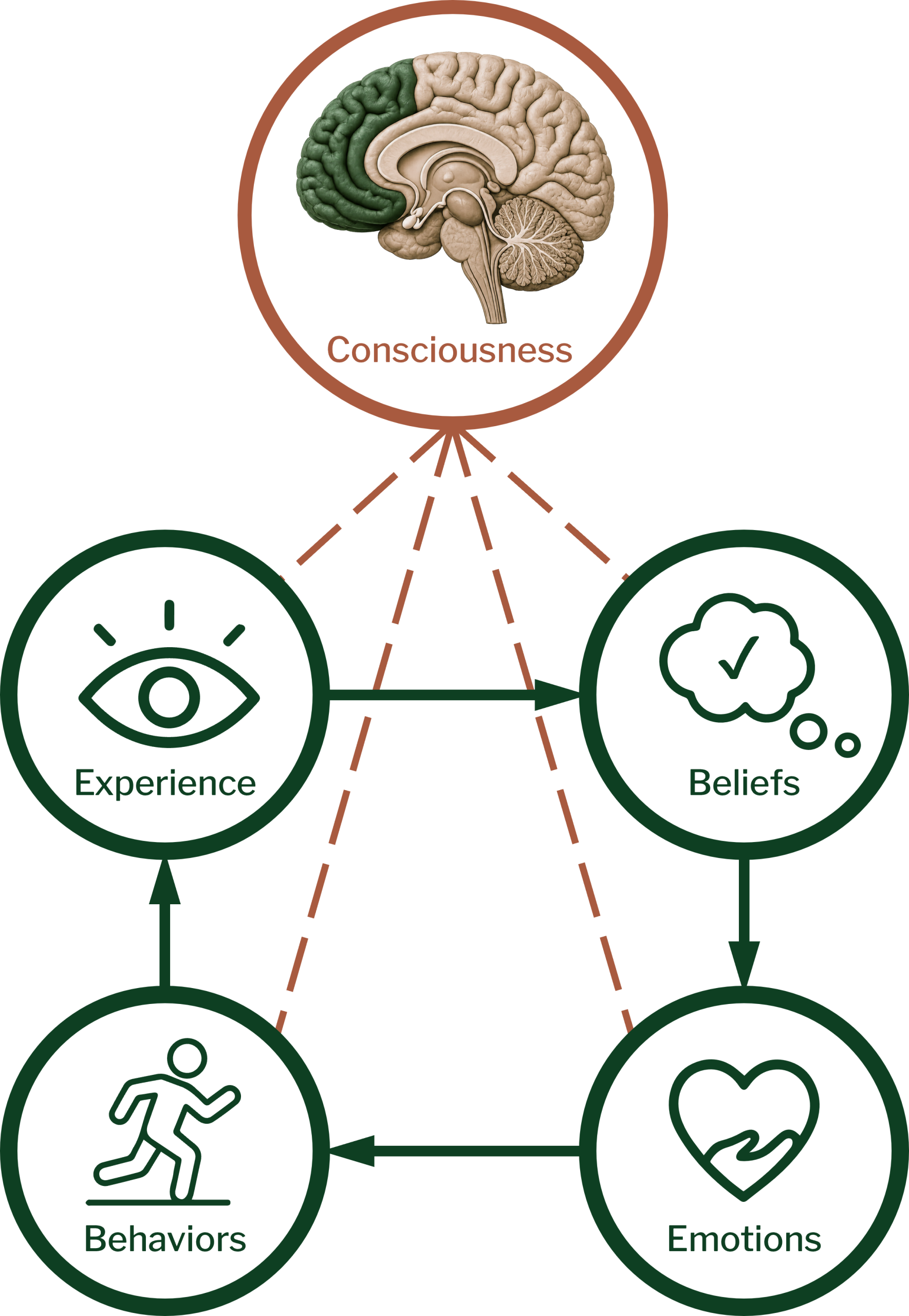
Consciousness is the ability to think about our own thinking.
Psychologists call it meta-cognition. It is the capacity to observe not just the world, but our own mental activity. We can have thoughts about our thoughts. We can have emotions about our emotions. We can notice that we are noticing.
This capacity appears to be unique to humans, and it relies heavily on the prefrontal cortex, the brain’s executive centre.
Try it now
Notice that you are reading these words. Now notice that there is a part of you aware that you are reading.
That awareness, the part that can watch you think, feel, and react, has been there the whole time. You are using it right now.
What the Observer Can Watch
Every stage of the cycle is available to observation, and so is the act of observing itself.
Experience
Noticing what our senses are reporting, before we decide what it means.
Stage TwoBeliefs
Catching a thought and recognising it as a thought rather than a fact.
Stage ThreeEmotions
Noticing a feeling instead of simply reacting to it.
Stage FourBehaviors
Seeing the pull toward an action while there is still room to choose.
We can even observe ourselves observing. That is the part no other animal appears to have.
Why the Observer Changes Everything
Nothing about the experience changes. What changes is whether we are inside it or watching it.
Observing the experience
- ✓I notice my thoughts.
- ✓I notice my emotions.
- ✓I choose an action.
In the experience
- ✗My thoughts are me.
- ✗My emotions are me.
- ✗My impulses are my reactions.
That space between what happens and how we respond is where lasting change begins.
The Observer and the Sense of Self
The observer is always available.
We simply lose sight of it when we become caught up in our thoughts, emotions, and reactions.
The moment we notice what is happening instead of being swept along by it, we are using the observer. It is a skill that grows with practice.
As the observer becomes stronger, we gain more freedom to question our beliefs, understand our emotions, and choose our behavior.
When our beliefs change our behaviors shift. This changes our ego and personality respectively.
Definitions
Ego
The collection of beliefs we hold about ourselves: our capabilities, our identity, and how we fit into the world. Not an entity to be conquered. Not an enemy. A set of beliefs.
Personality
The collection of behaviors that follow from that self-definition.
Where Choice Comes In
Most of what our brain decides happens without us. So where does choice actually live?
One
Pause
Interrupt the automatic run before it completes.
Two
Reflect
Look at the options actually available to us.
Three
Re-evaluate
Question our goals and values rather than assume them.
Four
Re-rank
Decide whether the goal our brain put first is the one that serves us.
The system is not a prison. It is a machine we can learn to operate.
The Myth of the Quiet Mind
Have you ever tried to make your mind go quiet? Then you already know the result.
What we try
- ✗Stop thinking.
- ✗Stop worrying.
- ✗Stop replaying it.
What happens
- ✗The thoughts get louder.
- ✗The worry demands attention.
- ✗It replays again.
What We Can Do Instead
We cannot switch the processing off. We can change what is being processed.
One
Notice
Catch that we are replaying the past or rehearsing the future
Two
Return
Bring attention back to the present moment
Three
Occupy
Give attention to something specific we are doing
Four
The Chatter Quiets
Not silence, a shift in what is being processed
Why This Works
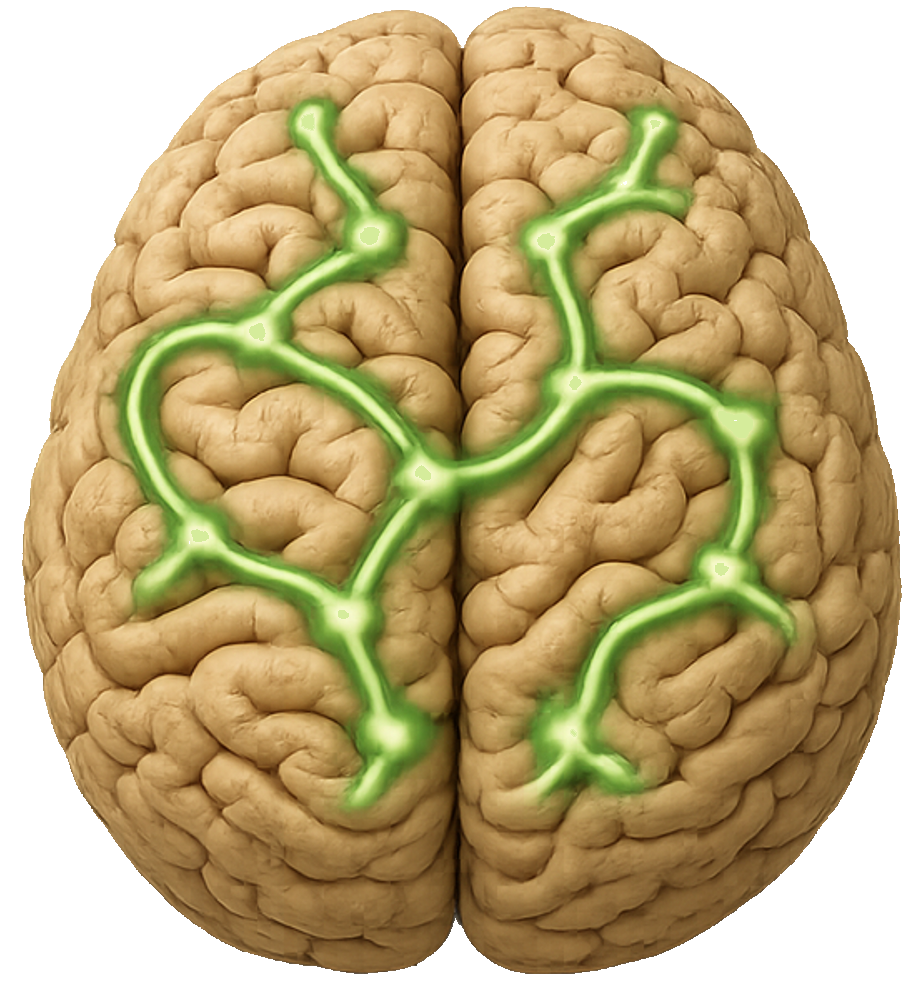
The brain has a Default Mode Network, the regions most active when we are not focused on the outside world. It is what runs when we daydream, replay memories, or imagine future scenarios, and it is the background chatter people mean when they say their mind will not shut off.
When we occupy our attention with present-moment information, the networks for focused attention become more active and the Default Mode Network becomes less active. The brain has not stopped processing. It has changed what it is processing.
That shift is what we are actually experiencing when we talk about quieting the mind.
There is a reason for that. The brain never stops processing. A silent mind was never the goal, and it was never available.
The goal is to watch what is happening rather than be swept away by it.
The Observer at Work
The observer is the operator of your mental system.
It is the part of you that uses the four skills: mindfulness, compassion, insight, and reframing. Every time you notice a feeling instead of reacting to it, you are already using it.
Observing is a skill. Like any skill, we can get better at it.